Running Cost Checker
What's your old aircon costing you to run?
Snap the silver rating plate on your unit — we'll read it and estimate what it costs to run all year, cooling in summer and heating in winter, then show what a rebated new unit would cost instead.
We built this for everyday households still running an older unit — especially the R22 and R410A era machines. Many people have no idea what theirs quietly adds to the power bill, or that a modern inverter unit can deliver the same comfort for a fraction of the running cost, often with a government rebate covering much of the swap.
It's the silver/white sticker — most of the time it's on the side of the outdoor unit (sometimes inside the indoor head). Look for “cooling capacity”, “power input” and the refrigerant type.
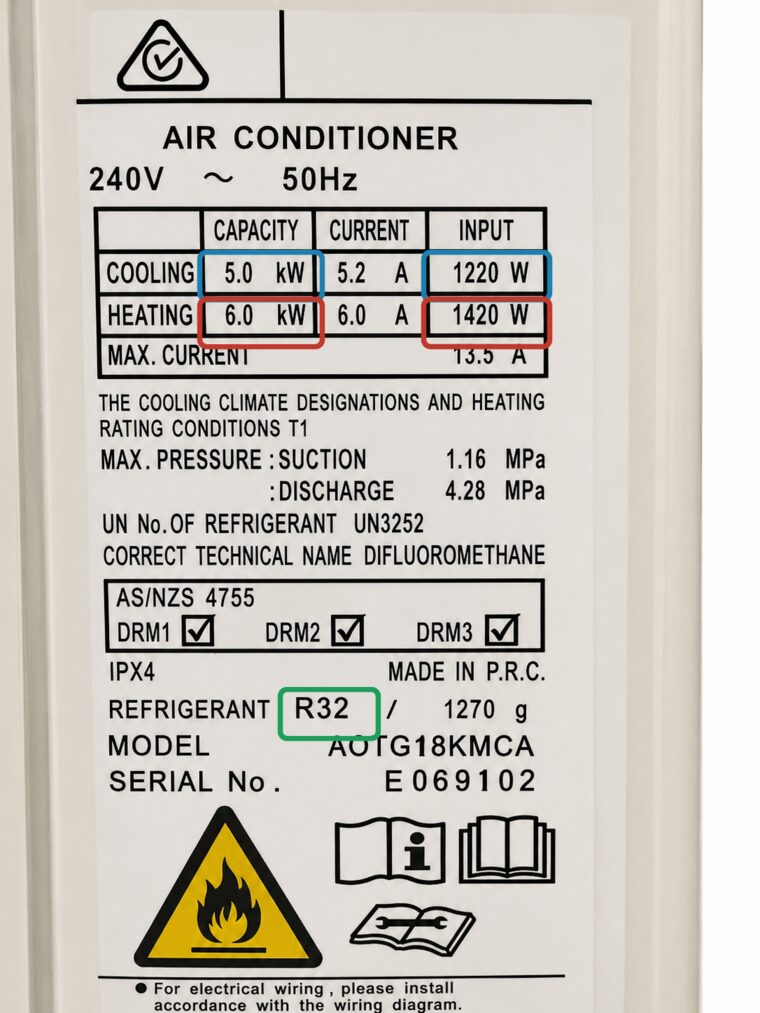
This is the sticker you're after — we read the cooling and heating rows, plus the refrigerant.
🤖 Our AI reads the plate straight from your photo in seconds — no typing.
Your photo is used only to read the plate. If a plate can't be read, we keep that photo for a short time to improve the reader — successfully read photos aren't stored.
We pre-fill what we read — check they're right, or type them in if you skipped the photo.
Both pairs are on the same plate — a COOLING row and a HEATING row. Skip heating and we'll estimate it from the cooling figures.
Fine tune your estimate (optional — for the pros who want a little more accuracy)
No calculator can land on your precise number — but you can get closer by playing with the variables that matter most: duty factor and insulation, plus a room size check for whether the unit is sized right. The duty presets are calibrated from real power-monitoring data shared by the community.
Estimate only. Real running costs vary with weather, thermostat settings, room size and insulation, unit condition, how the household actually uses it, and your tariff. Use the fine-tune panel above to sharpen it — and treat the figure as a guide, not a bill. The new unit comparison assumes the same running pattern, so for older fixed speed units the real saving is often larger than shown.
See what your upgrade qualifies for
We'll check your rebate and send back a fixed installed price — usually within one business day.
Estimate only. Based on the unit's rated power draw and the usage you entered (with the duty factor shown in the fine tune panel). Refrigerant GWP figures are indicative. The yearly figure adds summer cooling (about 16 weeks) and winter heating (about 18 weeks) at the hours you set for each. Heating figures are estimated from the cooling numbers unless you enter them. Real seasons vary with your climate, settings and tariff.
Running costs explained
How Much Does It Cost to Run an Air Conditioner?
Your air conditioner's running cost comes down to one simple sum: the power it draws in kilowatts, times the hours you run it, times your electricity rate (most Australian homes pay somewhere around 28–45c per kWh depending on the state and plan). The number that matters is the power input in kW on the rating plate — not the cooling capacity, which is the output.
Reverse cycle systems are cheap to run because they move heat rather than create it: a good unit delivers 3 to 5 kW of heating or cooling for every 1 kW of electricity it uses. That's why a modern high-efficiency unit can cost noticeably less to run than an older one of the same size — and why the calculator above compares your current unit against a new one.
What Does It Cost to Run Reverse Cycle Heating?
Cooling gets the attention, but across much of Australia winter heating is the bigger share of the bill — and it's where a reverse cycle system really earns its keep. Because a heat pump moves heat rather than burning fuel or glowing an element, it delivers around three to five units of warmth for every unit of electricity. That makes it the cheapest way to heat most homes — well below a gas heater or an old bar or fan heater for the same comfort.
Your unit's plate carries a separate heating capacity and power input (a HEATING row, just under the COOLING one), and it usually draws a little more power for heating than for cooling. The calculator above reads both rows, so the yearly figure is the full picture — summer cooling plus winter heating, not half of it. Use the Cooling / Heating toggle to set how you use it in each season.
Swapping ageing gas ducted heating for reverse cycle can also attract a government rebate — see the gas vs reverse cycle calculator or your state's rebate.
Typical Running Costs by System Size
Indicative only — figures assume roughly 6 hours of cooling a day across summer at about 33c/kWh for a unit in reasonable condition. Your real cost depends on efficiency, climate, settings and your tariff, so use the calculator above for your own unit.
| System | Typical power draw | Indicative summer cost |
|---|---|---|
| 2.5 kW split (bedroom) | ~0.7 kW | $120 – $180 / yr |
| 3.5 kW split (large room) | ~1.0 kW | $180 – $260 / yr |
| 5.0 kW split (living area) | ~1.5 kW | $280 – $400 / yr |
| 7.1 kW split (open plan) | ~2.1 kW | $400 – $560 / yr |
| Ducted (whole home) | 3 – 6 kW | $800 – $2,000+ / yr |
These are cooling-season figures only — add winter heating and the yearly total climbs again, which is why the calculator above works out both seasons for your unit. Reverse cycle is still usually the cheapest way to heat. If your unit is more than about ten years old, a new high-efficiency model can cut these figures, and a government rebate can cover much of the upgrade.
What Makes an Aircon Cost More to Run
Efficiency and age. Older fixed-speed units draw close to full power whenever they run. Modern inverter units modulate, and higher star ratings mean more output per kilowatt — the single biggest lever on running cost.
Size match. An undersized unit runs flat out; an oversized one short-cycles. Both waste power — our sizing calculator helps you get it right.
How you set it. Every degree counts. Around 24–26°C for cooling and 18–20°C for heating is the efficient zone; pushing past that can add 5–10% per degree.
Your home and climate. Insulation, west-facing glass, draughts and a hot local climate all make the unit work harder for the same comfort.
Refrigerant and condition. A unit low on gas, or running an old refrigerant like R22, works harder and costs more — the calculator flags this from your plate.
How to Cut Your Running Cost
Set a sensible temperature and use the timer so it isn't running in empty rooms. Close doors and zone where you can. Clean the filters every few months — a clogged filter makes the unit work harder. Use the sun: close blinds on hot afternoons, open them up in winter. Set heating to around 18–20°C rather than higher — every extra degree adds to the bill. And if the unit is old and inefficient, replacing it is often the biggest saving of all — especially when a rebate covers a large part of the cost.
Common Questions
How much does it cost to run an air conditioner per hour?
How do I work out what my air conditioner costs to run?
How much does it cost to run reverse cycle heating?
Does heating cost more to run than cooling?
Is reverse cycle cheaper to run than gas heating?
Does an old air conditioner use more power?
How accurate is this estimate?
Will a new unit really cost less to run?
See if your upgrade is rebated
Your state's scheme can take a big chunk off a new high-efficiency system — check your postcode in 30 seconds.
Check my rebate